
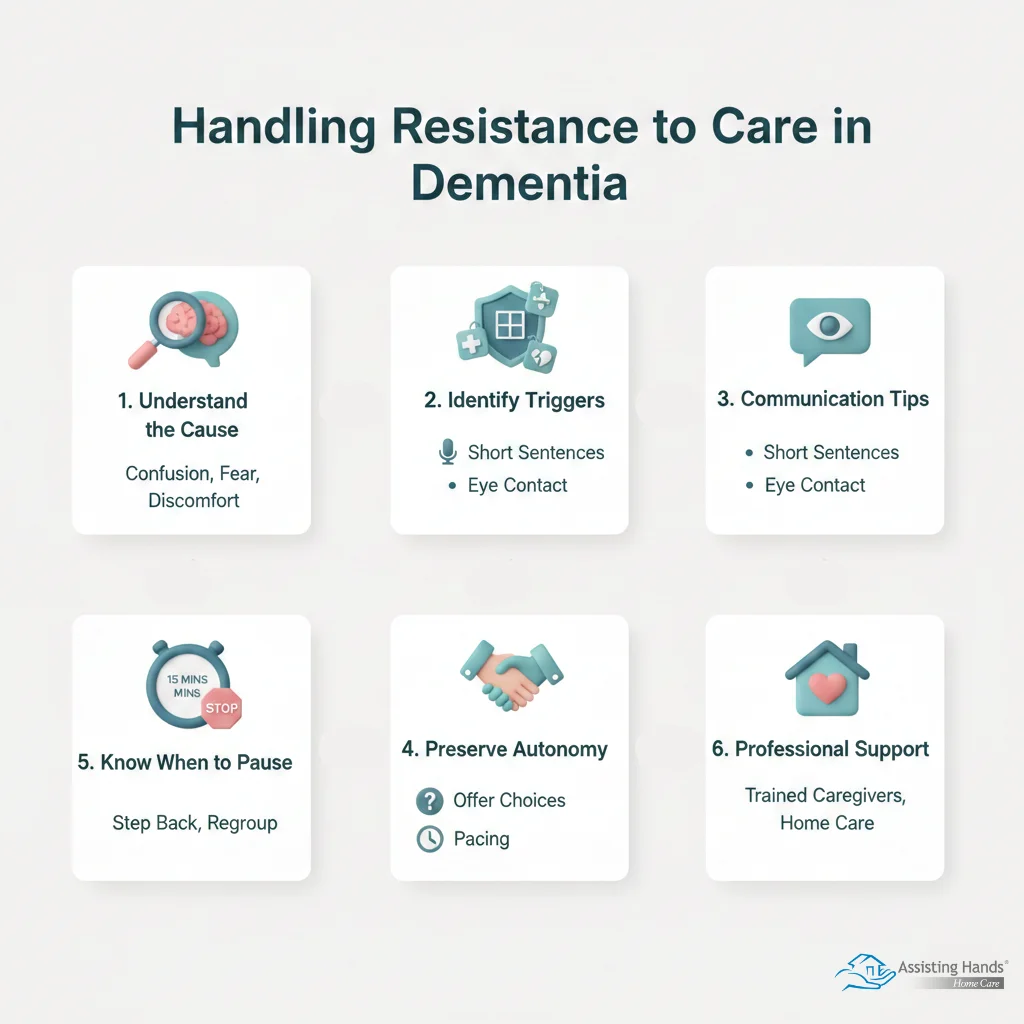
Resistance to care in someone with dementia is best handled by identifying the underlying cause, adjusting communication style, preserving autonomy, and knowing when to pause. This behavior is generally a response to confusion, fear, discomfort, or loss of control rather than intentional refusal. Addressing triggers and modifying the caregiving approach typically reduce agitation and enhance cooperation over time.
Caring for a senior loved one with dementia presents unique challenges, particularly when he or she resists help with daily activities like bathing, dressing, or taking medication. Rather than viewing this behavior as stubbornness or aggression, it’s crucial to recognize it as a symptom of the disease and a reaction to confusion, fear, or loss of control.
What Usually Causes Resistance to Care in People with Dementia?
Resistance is rarely personal. It’s often a form of communication when the person cannot find the right words. Before reacting to the behavior, try to act as a detective to uncover what might be triggering the refusal. Your loved one may not understand what you’re trying to do, or he or she may feel physically uncomfortable but unable to express it.
Common triggers for resistance include:
- Physical pain – Arthritis, dental issues, or infections can make movement painful.
- Environmental factors – The room might be too cold, too bright, or too noisy.
- Confusion – Your loved one may not recognize you or understand why he or she needs to undress for a shower.
- Fear – Your loved one might feel threatened by the sudden invasion of his or her personal space.
By identifying the trigger, you can address the root problem—such as treating pain or warming up the bathroom—rather than just battling the symptom.
How Can Communication Style Reduce Resistance during Care Tasks?
The way care is communicated often determines whether cooperation occurs. How you approach a task is often just as important as the task itself. If a caregiver approaches quickly, speaking loudly or using complex sentences, it can easily overwhelm someone with cognitive impairment. This overwhelm triggers a “fight or flight” response, leading to resistance.
To enhance cooperation, try adjusting your delivery:
- Use short, simple sentences – Give one direction at a time. Instead of “Go into the bathroom, take off your shirt, and get in the shower,” try “Let’s go to the bathroom.”
- Watch your body language – Approach from the front so you don’t startle your loved one. Maintain eye contact and keep a smile on your face to convey safety.
- Validate your loved one’s feelings – If your loved one says he or she doesn’t want to shower, acknowledge it. “I know it’s cold and you’d rather stay in bed, but we need to get you clean so you feel better.”
Trained caregivers who have experience in communicating with seniors with dementia can be a fantastic resource for family members. If your senior loved one has been diagnosed with a serious condition and needs help with tasks like meal prep, transportation, medication reminders, bathing, and grooming, reach out to Assisting Hands Home Care, a leading provider of Westminster Home Care. We also offer comprehensive care for seniors with dementia, Alzheimer’s, and Parkinson’s.
Why Does Preserving Control Reduce Care Refusal?
Preserving autonomy reduces resistance by maintaining dignity and reducing frustration. Nobody enjoys having things done to them. A loss of autonomy is a major source of frustration for adults with dementia who are used to being independent. When you take over a task completely, it reinforces your loved one’s helplessness. Instead, try to partner with your loved one in the activity.
Encourage participation to whatever degree is possible. Even if your loved one cannot dress him or herself entirely, perhaps he or she can button the shirt once you put it on. By bridging the gap between doing it for your loved one and letting him or her do it independently, you preserve his or her dignity.
Strategies to offer control include:
- Offering limited choices – Ask “Would you like the red shirt or the blue shirt?” rather than saying “Put this on.”
- Asking for help – Frame the activity as a favor. “Could you help me hold this washcloth?”
- Pacing – Allow plenty of time so your loved one doesn’t feel rushed, which often leads to anxiety and refusal.
These strategies are a cornerstone of effective dementia care at home, where preserving familiarity and dignity within the home environment plays a central role in reducing resistance.
Living with dementia can make it difficult for seniors to manage everyday tasks on their own. Certain age-related conditions can make it more challenging for older adults to age in place safely and comfortably, but experts in live-in care for Westminster seniors are available around the clock to help aging adults manage their health. Whether your loved one is living with dementia or recovering from a stroke, you can trust the professional caregivers from Assisting Hands Home Care to enhance his or her quality of life.
When Is It Best to Stop and Try Care Again Later?
Stepping back is often the safest and most effective option when resistance escalates. There will be moments when, despite your best efforts, resistance escalates into agitation or anger. In these moments, forcing the issue is rarely successful and can be dangerous for both you and your loved one. If safety isn’t immediately at risk, the best course of action is often to stop.
Forcing care when your loved one is agitated can damage trust and make him or her more resistant the next time. Instead, take a step back and give your loved one space. Leave the room for 15 minutes to allow your loved one to calm down, then try again later, perhaps using a different approach or a different caregiver if available. Sometimes, simply changing the subject or offering a favorite snack can break the tension enough to try the task again successfully.
Frequently Asked Questions
What causes resistance to care in individuals with dementia?
Resistance can stem from confusion, fear, embarrassment, or a lack of understanding about the need for assistance.
How do caregivers handle resistance to care?
Caregivers use patience, empathy, and gentle communication to build trust and encourage cooperation.
Can resistance to care be reduced over time?
Yes, consistent routines, familiar caregivers, and a calm approach can reduce resistance and foster acceptance.
What strategies do caregivers use to encourage participation in care?
Caregivers often use positive reinforcement, offer choices, and involve individuals in decision-making to promote engagement.
How can families support caregivers when resistance to care occurs?
Families can share insights about their loved ones’ preferences and triggers, helping caregivers tailor their approach effectively.
Aging in place can present a few challenges for seniors living with dementia. However, with professional dementia care that offers Westminster families peace of mind, they can still live independently at home. Families can rely on Assisting Hands Home Care to provide their elderly loved ones with mental and social stimulation, timely medication reminders, assistance with meal prep, and much more. Our caregivers are available around the clock to help your loved one live a happier and healthier life. Call today to speak with a friendly and experienced Care Specialist to formulate a home care plan for your loved one.