
Table of Content
- 1 How Does Environmental Overstimulation and Clutter Trigger Anxiety?
- 2 How Do Communication Frustrations Cause Anxiety?
- 3 How Do Unmet Physical Needs Manifest as Anxiety?
- 4 Why Do Changes in Routine and Unfamiliar Situations Provoke Such Strong Anxiety?
- 5 How Does Memory Loss Itself Become a Source of Anxiety and Disorientation?
- 6 Frequently Asked Questions
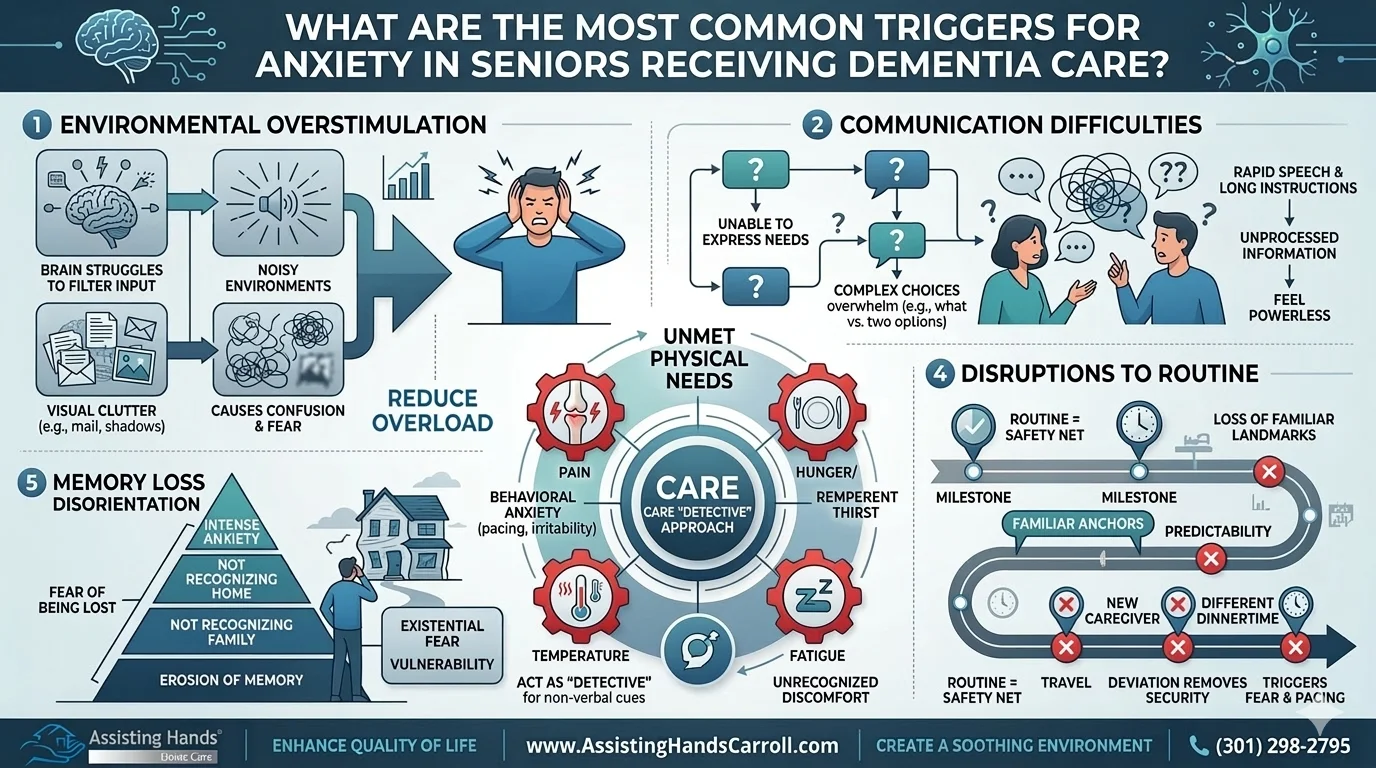
The most common anxiety triggers for seniors with dementia include environmental overstimulation, communication difficulties, unmet physical needs, disruptions to routine, and the disorientation caused by memory loss itself.
Caring for a senior loved one with dementia involves navigating a complex landscape of emotions, with anxiety being a frequent and distressing companion. By identifying specific triggers, you can create a more soothing environment and significantly enhance your loved one’s quality of life.
How Does Environmental Overstimulation and Clutter Trigger Anxiety?
A cluttered or overstimulating environment is one of the most frequent sources of anxiety in dementia patients because a slowing brain has difficulty filtering out excess sensory input a healthy adult would easily ignore. A room that seems normal to a healthy person can feel chaotic and threatening to someone with dementia.
High noise levels from televisions, radios, or multiple conversations happening at once can quickly lead to sensory overload. Similarly, visual clutter—such as patterned wallpapers, piles of mail, or poor lighting that creates confusing shadows—can cause disorientation. When the brain cannot make sense of these surroundings, the natural response is fear and agitation. Creating a calm, well-lit, and organized space is often the first line of defense against anxiety.
How Do Communication Frustrations Cause Anxiety?
Communication-related anxiety arises when seniors with dementia cannot express their own needs or process what’s being said to them, leaving them feeling overwhelmed and powerless.
Anxiety often spikes when a caregiver asks complex questions, speaks too quickly, or gives multistep instructions. For seniors with dementia, trying to process this information can feel like taking a test they haven’t studied for. Triggers in this category include:
- Complex choices – Being asked to choose between too many options (e.g., “What do you want for dinner?” vs. “Would you like chicken or fish?”)
- Rapid speech – Conversations that move faster than your loved one can process
- Tone of voice – Sensing impatience or frustration in the caregiver’s voice, even if the words are kind
How Do Unmet Physical Needs Manifest as Anxiety?
When dementia prevents a senior from identifying or verbalizing physical discomfort, that discomfort frequently surfaces as behavioral anxiety rather than a direct complaint. Your loved one may pace, wring his or her hands, or become irritable because he or she is in pain but cannot say “My back hurts” or “I have a headache.”
Caregivers should act as detectives when anxiety arises suddenly. Common physical triggers include:
- Pain – Arthritis, dental issues, or infections (such as UTIs) that go untreated
- Hunger or thirst – Dehydration that causes confusion or low blood sugar that can lead to jitters and irritability
- Temperature – Being too hot or too cold without the ability to adjust clothing or the thermostat
- Fatigue – Exhaustion that lowers the threshold for stress, making anxiety more likely later in the day
The cognitive challenges that accompany dementia often leave aging adults unable to manage everyday tasks, which puts their safety and health at risk. If your senior loved one has been diagnosed with a serious condition and needs help with tasks like meal prep, transportation, medication reminders, bathing, and grooming, reach out to Assisting Hands Home Care, a leading provider of Westminster home care. We also offer comprehensive care for seniors with dementia, Alzheimer’s, and Parkinson’s.
Why Do Changes in Routine and Unfamiliar Situations Provoke Such Strong Anxiety?
Routine serves as a critical safety net for individuals with memory loss, and any disruption to that structure removes the anchors they depend on to feel secure throughout the day. Consequently, any deviation from the norm can trigger a severe anxious response.
This anxiety is often triggered by travel, hospitalization, or even minor changes like a new caregiver or a different dinnertime. The loss of familiar landmarks—whether they’re physical places or temporal routines—removes the anchors your loved one relies on to navigate the day. Even houseguests or changes in home décor can be enough to disrupt the sense of safety, leading to pacing, shadowing the caregiver, or repetitive questioning.
Symptoms such as agitation, confusion, anger, and frustration are common in elderly people with dementia. Certain age-related conditions can make it more challenging for older adults to age in place safely and comfortably, but experts in live-in care for Westminster seniors are available around the clock to help aging adults manage their health. Whether your loved one is living with dementia or recovering from a stroke, you can trust the professional caregivers from Assisting Hands Home Care to enhance his or her quality of life.
How Does Memory Loss Itself Become a Source of Anxiety and Disorientation?
At the core of dementia is the erosion of memory, and the resulting disorientation produces intense anxiety rooted in the fear of being lost and vulnerable. Anxiety often stems from the terrifying realization that your loved one doesn’t know where he or she is or who’s with him or her.
It’s common for dementia patients to not recognize their own homes, believing they need to “go home” to childhood residences that may no longer exist. They may not recognize their spouses or children, viewing them instead as strangers or intruders. This profound disorientation triggers the body’s “fight or flight” response. This type of anxiety is existential. It’s the fear of being alone and in danger, even when sitting in a familiar living room.
Caring for seniors with dementia can be challenging for family caregivers. Luckily, there is dementia care Westminster families can rely on. Professional dementia caregivers help seniors with dementia stay safe and comfortable at home by preventing wandering, providing cognitive stimulation, and assisting with household chores. Call Assisting Hands Home Care to learn more about our flexible and customizable senior care plans.
Frequently Asked Questions
What are dementia care services?
+
Dementia care services provide specialized support for individuals with memory loss, focusing on safety, daily assistance, and cognitive engagement.
How is dementia care tailored to individual needs?
+
Care plans are personalized with routines, activities, and support designed to address the unique challenges of dementia.
What types of activities are included in dementia care?
+
Activities often include memory exercises, social interaction, physical movement, and calming techniques to enhance wellbeing.
Are dementia care providers specially trained?
+
Yes, caregivers receive specialized training to understand dementia-related behaviors and provide compassionate, effective care.
Does insurance cover dementia care services?
+
Coverage varies, but some costs may be covered by long-term care insurance, Medicaid, or other programs.